Connect with us

Technology

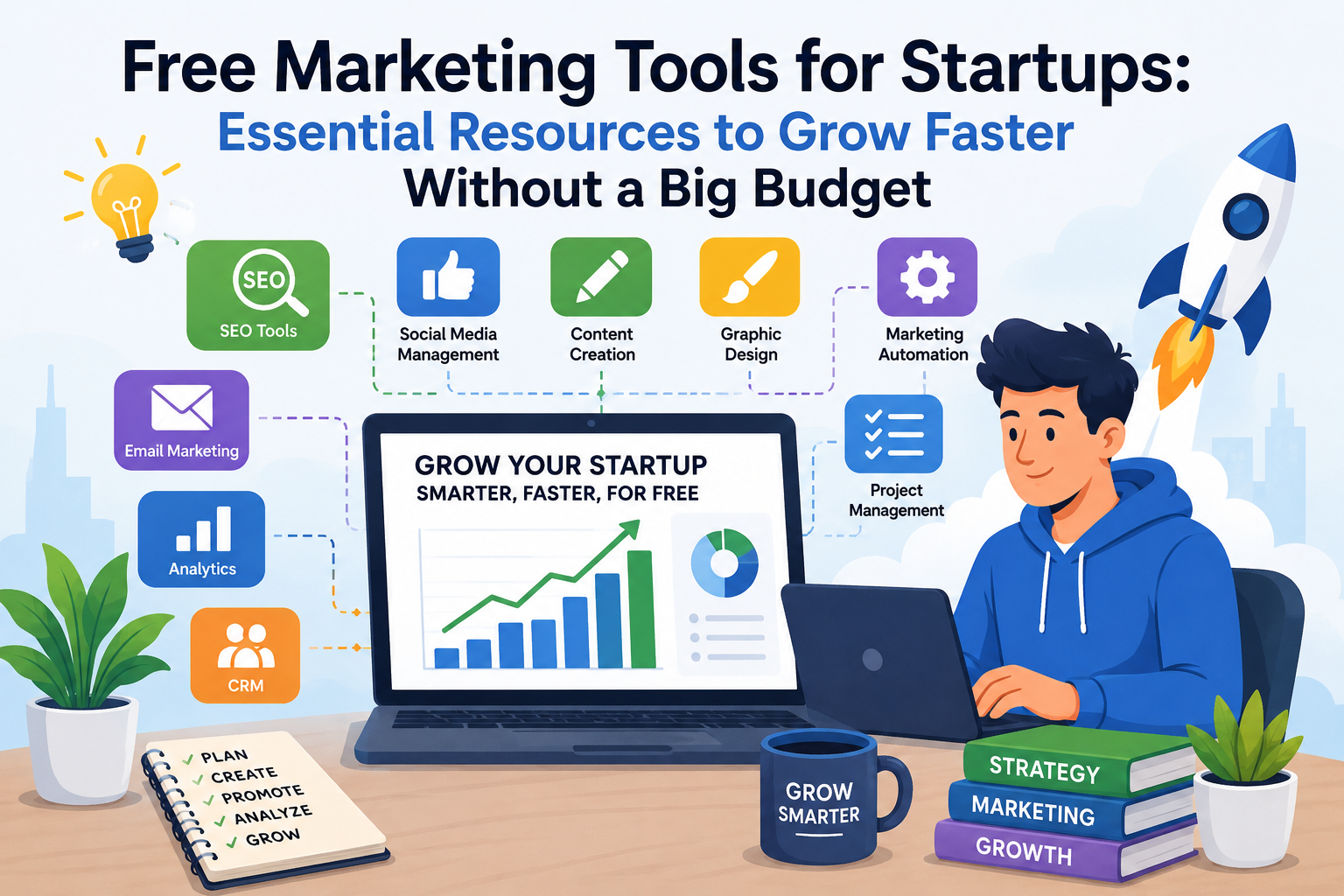
Free Marketing Tools for Startups: Essential Resources to Grow Faster Without a Big Budget

Published

on

Free marketing tools for startups

Starting a startup often means working with limited resources while trying to maximize visibility and customer acquisition The right free marketing tools for startups can help founders compete with larger brands, streamline campaigns, and make smarter decisions without stretching their budgets This guide explores practical tools, strategies, and categories that can help startups build a sustainable marketing foundation.

Quick Bio

Feature Details
Keyword Free Marketing Tools for Startups
Core Definition Software and platforms that help startups market products and services at no cost
Origin Emerged alongside SaaS and freemium software business models
Primary Use Customer acquisition, brand awareness, lead generation, and growth
Industry Marketing Technology (MarTech), SaaS, Digital Marketing
Common Materials Cloud-based software, dashboards, automation systems, analytics platforms
Popular Applications SEO, email marketing, social media management, content creation, analytics, CRM
Main Users Startup founders, marketers, entrepreneurs, small businesses
Cost Structure Free plans, freemium models, open-source tools
Key Benefit Enables growth without significant marketing expenditure

Why Startups Need Free Marketing Tools

Starting out means going up against crowded markets while working with tight budgets. Because they need results fast, entrepreneurs turn to zero-cost promotion platforms – this helps them see what sticks, check if their approach works, then grow recognition without spending early on.
One thing these tools do is cut down on cluttered processes, folding automation together with analysis and handling materials all inside one system. Instead of juggling separate parts, everything runs through a shared path, smoothing out how tasks move forward.

The Evolution of Startup Marketing Software

Marketing once required expensive agencies, software licenses, and large teams. Modern cloud-based platforms have changed the landscape by offering free plans that support startups during their early growth stages.

Freemium business models have made sophisticated marketing technology accessible to businesses of all sizes.

Categories of Free Marketing Tools for Startups

Different marketing goals require different solutions.

Common categories include:

  • SEO tools
  • Email marketing platforms
  • Social media management software
  • CRM systems
  • Analytics platforms
  • Graphic design tools
  • Marketing automation software
  • Content creation tools

Free SEO Tools for Startup Growth

Keyword Research Solutions

Keyword research helps startups understand customer search behavior. Free tools can reveal search volume, related phrases, and content opportunities.

Popular functions include:

  • Search trend analysis
  • Long-tail keyword discovery
  • Competitor keyword research
  • Content topic generation

Technical SEO Resources

Technical SEO tools identify crawl errors, broken links, indexing issues, and site performance problems.

Regular audits improve visibility and search engine rankings over time.

Free Email Marketing Platforms

Email remains one of the highest ROI marketing channels available.

Free email marketing solutions often provide:

  • Subscriber management
  • Newsletter creation
  • Basic automation
  • Audience segmentation
  • Performance tracking

Startups can nurture leads and retain customers without significant expenses.

Social Media Management Tools

Managing multiple social platforms manually can consume valuable time.

Social media tools help startups:

  • Schedule content
  • Monitor engagement
  • Track performance
  • Maintain posting consistency
  • Manage multiple accounts

Consistent activity often contributes to stronger brand recognition.

Content Creation and Copywriting Tools

Content marketing plays a central role in startup growth.

Useful content-related solutions include:

  • Blog writing assistants
  • Grammar checkers
  • Headline analyzers
  • Content planners
  • Research platforms

Quality content builds authority and attracts organic traffic.

Graphic Design Tools for Brand Building

Visual branding influences customer perception.

Many free design platforms allow startups to create:

  • Social media graphics
  • Infographics
  • Presentations
  • Marketing banners
  • Product promotions

Professional visuals increase engagement and improve brand consistency.

Customer Relationship Management (CRM) Platforms

A CRM system helps startups organize customer interactions.

Benefits of Free CRM Software

Key advantages include:

  • Lead tracking
  • Contact management
  • Sales pipeline monitoring
  • Customer communication history
  • Reporting dashboards

A structured CRM process often improves conversion rates.

Analytics and Performance Tracking Tools

Marketing decisions should be driven by data.

Analytics platforms provide insights into:

  • Website traffic
  • User behavior
  • Conversion paths
  • Campaign performance
  • Audience demographics

These metrics help startups allocate resources more effectively.

Marketing Automation Tools

Automation eliminates repetitive marketing tasks.

Examples include:

  • Automated email sequences
  • Lead nurturing workflows
  • Social media scheduling
  • Customer onboarding campaigns
  • Reporting automation

Automation allows small teams to scale their efforts efficiently.

Free Collaboration and Project Management Tools

Marketing campaigns often involve multiple stakeholders.

Collaboration platforms support:

  • Task assignment
  • Content calendars
  • Team communication
  • Campaign planning
  • Workflow management

Better organization leads to faster execution.

Startup Marketing Strategies Using Free Tools

A practical startup strategy often combines multiple tools.

Typical workflow:

  1. Research keywords.
  2. Create optimized content.
  3. Design promotional assets.
  4. Schedule social posts.
  5. Capture leads.
  6. Nurture subscribers.
  7. Measure performance.
  8. Optimize campaigns.

This approach creates a repeatable growth system.

Common Challenges When Using Free Marketing Tools

Free plans usually include limitations.

Potential restrictions include:

  • Usage caps
  • Limited integrations
  • Reduced storage
  • Branding requirements
  • Smaller contact limits

Understanding these limitations helps startups plan future upgrades strategically.

Emerging Trends in Startup Marketing Technology

Marketing technology continues evolving rapidly.

AI-Powered Marketing Assistance

Artificial intelligence is increasingly helping startups:

  • Generate content ideas
  • Analyze customer behavior
  • Improve personalization
  • Optimize campaigns
  • Automate routine tasks

AI adoption is expected to become a standard component of startup marketing operations.

Privacy-Focused Marketing

As privacy regulations expand, startups are prioritizing:

  • First-party data collection
  • Consent management
  • Transparent customer communication
  • Ethical analytics practices

Trust has become a competitive advantage.

How to Choose the Right Free Marketing Tools

Not every startup needs every tool.

Evaluate platforms based on:

  • Business goals
  • Team size
  • Integration capabilities
  • Ease of use
  • Scalability
  • Reporting features

Selecting tools that align with current objectives prevents unnecessary complexity.

Conclusion

Startups often grow fastest when they skip expensive software. Instead of spending cash, smart teams turn to free tools that handle big tasks. One way to get noticed online? Work on search rankings slowly over time. Another path opens through messages sent directly to interested people. Scheduling posts ahead helps keep followers engaged without daily effort. Watching numbers change teaches what works – and what fails. Letting machines do repetitive jobs frees up hours each week. Keeping track of who likes your product makes conversations easier later. Pick helpers that fix today’s problems but won’t need replacing tomorrow. Systems built now should stretch as things pick up speed.

FAQs

1. What are the most important free marketing tools for startups?

The most valuable categories include SEO tools, email marketing platforms, CRM software, analytics tools, social media schedulers, and content creation solutions. Together, they cover the core marketing functions required for growth.

2. Can startups grow successfully using only free marketing tools?

Many startups begin with free solutions and achieve significant growth. While premium features may eventually become necessary, free tools often provide enough functionality for early-stage customer acquisition and brand building.

3. How do free marketing tools generate revenue for providers?

Most operate under a freemium model. Basic features remain free, while advanced capabilities, higher usage limits, integrations, and enterprise support are available through paid subscriptions.

4. Which marketing channel offers the best return for startups?

The answer varies by industry, but content marketing, SEO, and email marketing frequently deliver strong long-term returns because they compound over time and can continue generating leads after initial creation.

5. How should startups prioritize marketing tools when budgets are limited?

Start with essentials: analytics, SEO research, email marketing, and CRM software. Once these foundations are established, add automation, social media management, and advanced content marketing tools as growth accelerates.

Continue Reading
Click to comment

Leave a Reply

Your email address will not be published. Required fields are marked *

Business

Indexdjx: .dji Explained: Meaning, Dow Jones Use, Market Data and Investor Guide

Published

on

Indexdjx: .dji

Indexdjx: .dji is not a company stock It is a market index symbol connected with the Dow Jones Industrial Average For readers, traders, and publishers, it helps identify one of the most watched U.S. stock market benchmarks.

Quick Bio

Feature Details
Core Definition Indexdjx: .dji commonly refers to the Dow Jones Industrial Average listing format used on finance platforms.
Full Name Dow Jones Industrial Average, often shortened to DJIA, Dow Jones, or the Dow.
Origin First introduced in 1896 as a market average created to track major U.S. industrial companies.
Primary Use Used to follow the performance of major U.S. blue-chip stocks.
Industry Stock market, financial media, investing, trading, economic analysis, and business reporting.
Common Data Inputs Component stock prices, index divisor, corporate actions, price changes, historical charts, and market feeds.
Popular Applications Market news, chart analysis, economic headlines, portfolio tracking, ETFs, futures, options, and investor sentiment checks.

What Does Indexdjx: .dji Mean?

What shows up as Indexdjx sometimes appears elsewhere as .dji – it’s just how certain systems tag the Dow Jones Industrial Average. Different platforms handle labeling in their own way, mixing index names with source markers. One place might use a dot prefix, another skips it entirely. The meaning stays fixed even if formatting shifts across tools.
Now here’s where .dji matters most – it stands for the Dow Jones Industrial Average. To tell it apart from regular stock symbols, people use Indexdjx since this isn’t just one company trading on a board. Instead, it tracks a whole group of them together.

Why Indexdjx: .dji Matters

People search for Indexdjx: .dji when they want fast Dow Jones data, chart movement, opening price, closing price, or market direction. It is especially common among users checking Google Finance, market dashboards, brokerage platforms, and financial news pages.

The Dow is often treated as a quick signal for the wider U.S. stock market. Even though it contains only 30 major companies, it still carries strong media influence because it has been quoted for more than a century.

Breaking Down the Symbol

The phrase Indexdjx: .dji can be understood in two parts. Indexdjx signals the index-data category, while .dji represents the Dow Jones Industrial Average ticker format.

This matters because a beginner may confuse it with a company ticker. A stock like Apple or Microsoft represents one company, but Indexdjx: .dji represents a basket of major U.S. companies combined into one market average.

Historical Origin of the Dow

The Dow Jones Industrial Average began in the late 19th century, when financial reporting was much simpler than it is now. Charles Dow wanted a practical way to measure how leading American businesses were performing.

At first, the index reflected the industrial character of the U.S. economy. Over time, its meaning expanded. Today, Indexdjx: .dji connects readers to companies across technology, finance, healthcare, consumer goods, industrials, and other major sectors.

How the Dow Jones Industrial Average Is Calculated

The Dow is a price-weighted index. That means higher-priced component stocks have more influence on index movement than lower-priced component stocks.

This is different from a market-cap-weighted index, where the largest companies by total market value usually carry the most weight. With Indexdjx: .dji, the price of each component stock plays a central role in daily movement.

Price-Weighted Logic in Plain English

Imagine one Dow component rises by several dollars while another rises by only a few cents. The dollar move matters more than the percentage move in a price-weighted structure.

That is why a high-priced Dow stock can move the index more strongly than a lower-priced company with a larger market value. This is one reason analysts often compare Indexdjx: .dji with the S&P 500 and Nasdaq Composite before making broad market judgments.

Core Data Inputs Behind Indexdjx: .dji

The main “materials” behind Indexdjx: .dji are not physical materials. They are financial data points.

The index depends on component stock prices, a special Dow divisor, corporate actions such as stock splits, and official index methodology. Chart platforms then turn that data into candles, line graphs, percentage changes, 52-week ranges, and historical performance views.

Modern Applications for Investors and Publishers

Investors use Indexdjx: .dji to check whether blue-chip U.S. stocks are rising or falling. Financial writers use it in headlines because readers instantly recognize the Dow as a market signal.

It is also useful for comparing investor mood. A rising Dow may suggest stronger confidence in established companies, while a falling Dow can signal pressure in major sectors of the U.S. economy.

For content publishers, related terms include Dow Jones today, DJIA chart, Dow futures, Dow 30 companies, U.S. stock market index, blue-chip stocks, and Wall Street market update.

How It Differs From S&P 500 and Nasdaq

Indexdjx: .dji tracks the Dow, which has 30 major U.S. companies. The S&P 500 tracks around 500 large U.S. companies, making it broader.

The Nasdaq Composite is more technology-heavy because it includes many companies listed on the Nasdaq exchange. The Dow is narrower, older, and more selective, which makes it useful but not complete on its own.

A smart market reader should compare all three. The Dow may rise while the Nasdaq falls, especially when technology stocks are under pressure but industrial or financial stocks are stronger.

Regional and Global Market Connection

Although Indexdjx: .dji is tied to the U.S. market, it is watched globally. Traders in Asia, Europe, the Middle East, and other regions often check Dow movement before or after U.S. trading hours.

Global investors also watch Dow futures before the New York session opens. These futures can influence early market expectations, although they do not guarantee where the Dow will close.

For international readers, the Dow often appears beside other benchmarks such as the FTSE 100, DAX, Nikkei 225, Hang Seng Index, and S&P/TSX Composite.

Commercial Variations and Tradable Products

You cannot directly buy Indexdjx: .dji like a normal stock because it is an index. However, investors can access Dow exposure through related financial products.

Common variations include Dow ETFs, DJIA futures, Dow options, and index-linked funds. These products are designed for different goals, from long-term tracking to short-term trading.

Popular searches around this topic include Dow Jones ETF, DIA ETF, E-mini Dow futures, Dow options, and DJIA historical performance.

Common Misreadings and Investor Mistakes

One common mistake is assuming Indexdjx: .dji represents the whole stock market. It does not. It represents 30 selected blue-chip companies.

Another mistake is reacting to one-day movement without checking sector leadership, inflation data, Federal Reserve news, earnings reports, or global events. The Dow is useful, but it should be read with context.

Beginners should also remember that an index quote is not investment advice. It is a market measurement tool.

Future Trends Around Dow Tracking

Now it’s different when people keep up with Indexdjx: .dji. Checking stock updates feels smoother through phone apps made for money tracking. Some tools use artificial intelligence to shrink long reports into quick insights. Live screens update without needing a refresh button. Notifications arrive the moment numbers shift. Reading about the Dow does not take so much effort anymore. Picture this – watching markets could soon mean seeing real-time visuals flow across screens, layered with crowd density patterns that show where activity clusters. Heat in certain zones might tell stories words can’t. Past moves may line up beside today’s action, offering context without clutter. When things shift, the why might come through risk lenses instead of guesses. Through it all, one thing sticks: icons matter. Folks still reach for familiar markers when sorting noise from signal.

FAQs About Indexdjx: .dji

1. What is Indexdjx: .dji?

Indexdjx: .dji is a finance-platform label connected with the Dow Jones Industrial Average. It helps users find Dow data, charts, price movement, and market information.

2. Is Indexdjx: .dji a stock I can buy?

No. Indexdjx: .dji is not a single company stock. It represents an index. Investors usually gain Dow exposure through ETFs, futures, options, or funds that track the Dow.

3. Why does the Dow matter if it has only 30 companies?

The Dow matters because its companies are large, established, and widely followed. It also has deep historical importance and strong media recognition, so many investors use it as a quick market signal.

4. How is Indexdjx: .dji different from the S&P 500?

Indexdjx: .dji follows the Dow’s 30 blue-chip companies and uses a price-weighted method. The S&P 500 is much broader and uses market-cap weighting, so it often gives a wider view of the U.S. stock market.

5. Why do finance platforms show different formats for the Dow symbol?

Different platforms use different symbol structures. Some show .DJI, others show DJIA, ^DJI, or a format like Indexdjx: .dji. These variations usually point to the same Dow Jones Industrial Average data.

Conclusion

Indexdjx: .dji is best understood as a market-data symbol for the Dow Jones Industrial Average, one of the most recognized stock market benchmarks in the world. It helps users track blue-chip U.S. stocks, read market direction, compare major indexes, and understand financial headlines faster. For the best results, do not read the Dow alone. Compare it with the S&P 500, Nasdaq Composite, Dow futures, sector performance, earnings news, interest-rate updates, and global market signals. That gives a clearer, more useful picture than any single index quote can provide.

Disclaimer:

This article is for informational and educational purposes only. It does not provide financial, investment, trading, or legal advice. Stock market indexes such as Indexdjx: .dji and the Dow Jones Industrial Average can change due to market conditions, economic news, and investor sentiment. Always do your own research or consult a qualified financial advisor before making any investment or trading decision.

Also Read:> Indexdjx: .dji Explained: Meaning, Dow Jones Use, Market Data and Investor Guide

Continue Reading

Technology

Techsslassh.com: The Digital Shortcut for Curious Minds in a Noisy Tech World

Published

on

Techsslassh.com

Introduction

Technology doesn’t wait for anyone. One minute you’re learning about a new app, and the next, everyone’s talking about artificial intelligence, smarter gadgets, privacy updates, digital shortcuts, and tools that promise to “change everything.” Honestly, it can feel like trying to drink from a fire hose. That’s where a clear, friendly tech space becomes useful. Instead of throwing heavy jargon at readers, a good technology platform should explain things like a smart friend sitting across the table, coffee in hand, saying, “Relax, I’ll break it down.”

At its heart, Techsslassh.com can be imagined as that kind of digital corner: simple, fresh, helpful, and built for people who want to understand technology without feeling lost. Whether someone is a student, blogger, small business owner, gamer, remote worker, or just a naturally curious person, the right tech content can save time, reduce confusion, and even spark new ideas.

Why Simple Tech Content Matters Today

Let’s face it: most people don’t want a textbook every time they search for an answer. They want clarity. They want examples. They want to know what something means, why it matters, and how it affects everyday life.

Technology is no longer limited to coders, engineers, or IT experts. It sits in our pockets, runs our businesses, shapes our entertainment, protects our money, and even helps us cook dinner. Because of that, tech writing needs to feel human. It shouldn’t sound like a robot swallowed a dictionary.

The Problem With Overcomplicated Tech Advice

A lot of tech content online feels like it was written for machines, not people. You click an article hoping to learn one simple thing, and suddenly you’re buried under acronyms, buzzwords, and sentences that seem to go in circles.

That’s frustrating, isn’t it?

Good technology content should do three things well:

  • Explain difficult ideas in plain English.
  • Give practical examples people can actually use.
  • Help readers make better decisions without wasting their time.

When content does that, readers don’t just skim and leave. They trust it. They return. They share it. And, most importantly, they learn something useful.

The Modern Reader Wants Speed, But Not Shallowness

Here’s the tricky part: people want fast answers, but they don’t want empty ones. A short answer can be helpful, sure. However, if it misses context, readers may still walk away confused.

That’s why strong tech articles need balance. They should be quick enough to read but deep enough to matter. A reader might come looking for a simple explanation of cloud storage, website security, smartphones, software tools, or online privacy. Still, they may also need examples, pros and cons, steps, and warnings.

In other words, don’t just say what something is. Show why it matters.

A Helpful Tech Article Feels Like a Map

Imagine standing in a huge city without signs. Roads everywhere, lights blinking, people rushing past. That’s what the internet can feel like. A helpful article acts like a map. It doesn’t walk for you, but it points you in the right direction.

A strong tech guide usually includes:

  1. A clear explanation of the topic.
  2. Real-life examples.
  3. Simple steps or tips.
  4. Mistakes to avoid.
  5. A final takeaway that sticks.

That structure turns confusion into confidence. And really, that’s the whole point.

What Makes a Tech Platform Feel Trustworthy?

Trust is everything online. Readers are smarter than many websites think. They can feel when content is rushed, copied, stuffed with keywords, or written only to chase search rankings. On the other hand, they can also feel when an article has care behind it.

A trustworthy tech platform uses clear language, checks facts, avoids wild claims, and respects the reader’s time. It doesn’t pretend every tool is perfect. It doesn’t hype every trend like it’s the next moon landing. Instead, it says, “Here’s what works, here’s what doesn’t, and here’s what you should know before jumping in.”

Signs of Useful Technology Content

Good content often has a natural rhythm. It doesn’t lecture. It explains. It doesn’t shout. It guides. And yes, it may even sound a little casual because real people don’t talk like instruction manuals all day.

Useful tech content should be:

  • Clear: Easy to understand from the first paragraph.
  • Honest: No fake promises or exaggerated claims.
  • Practical: Focused on real problems and real solutions.
  • Current: Aware that tech changes quickly.
  • Readable: Smooth, friendly, and not painfully formal.

When all of these come together, readers feel like they’ve found a reliable place.

Technology Is Not Just About Devices Anymore

Years ago, when people heard the word “technology,” they often thought of computers, phones, or maybe televisions. Now, technology touches almost every part of life. It shapes shopping, banking, education, healthcare, travel, entertainment, marketing, and even relationships.

A small business owner may use automation tools to reply to customers faster. A student may use note-taking apps to organize classes. A parent may use safety settings to protect children online. A traveler may compare hotels, routes, and reviews in minutes.

See the pattern? Technology isn’t just “tech” anymore. It’s daily life with a power button.

Everyday Areas Where Tech Content Helps

A useful digital publication can cover many topics without becoming messy. The secret is organization. Readers should easily find what they need.

Common areas may include:

  • Mobile apps and smartphone tips
  • Website tools and online business advice
  • Cybersecurity and privacy basics
  • Artificial intelligence explained simply
  • Gaming updates and device guides
  • Software reviews and comparisons
  • Social media trends and digital culture
  • Smart home gadgets and lifestyle tech

Each topic has value when written with the reader in mind.

Making Sense of Trends Without Falling for Hype

New trends pop up constantly. One day everyone talks about blockchain. Then it’s virtual reality. Then AI tools. Then smart glasses. Then some mysterious app everyone swears is “the future.” Whew!

But not every trend deserves panic or applause. Some are useful. Some are overhyped. Some are still too early. Others quietly become part of daily life before people even notice.

That’s why tech writing should slow things down a bit. Instead of yelling, “This changes everything,” a better approach is to ask, “Who does this help, what problem does it solve, and what should users watch out for?”

Questions Readers Should Ask About Any New Tool

Before trusting a new app, platform, or gadget, readers should think carefully. A shiny interface doesn’t always mean a smart product.

Here are some useful questions:

  1. Does this tool solve a real problem?
  2. Is it easy to use?
  3. Does it protect personal data?
  4. Is the price fair?
  5. Are there better alternatives?
  6. Will it still be useful next month?
  7. What are real users saying about it?

These questions keep people from chasing every new digital rabbit hole.

The Human Side of Technology

It’s easy to forget that technology is built for people. Behind every app, website, device, or digital service, there’s a human need. Someone wants to save time. Someone wants to feel safer. Someone wants to create, learn, earn, connect, or simply have fun.

That’s why tech content should never feel cold. The best articles understand that users aren’t just looking for features. They’re looking for confidence.

A person reading about password managers may actually be worried about losing access to important accounts. Someone comparing laptops may be trying to make the best purchase with limited money. A beginner learning about website hosting may be nervous about making a costly mistake.

Good writing sees that. It doesn’t just explain the tool. It respects the person using it.

How Readers Can Get More Value From Tech Articles

Reading tech content is helpful, but using it wisely is even better. Instead of jumping from one article to another, readers should slow down and apply what they learn.

Here’s a simple method:

  • Read with a goal: Know what problem you’re trying to solve.
  • Take quick notes: Write down tools, tips, or warnings.
  • Compare sources: Don’t rely on one opinion only.
  • Test carefully: Try free versions before paying.
  • Review results: Ask yourself whether the advice worked.

That may sound basic, but it works. A little patience saves a lot of headaches later.

Don’t Believe Everything Instantly

Online content can be helpful, but not all of it is accurate. Some articles are outdated. Some are biased. Some are written only to sell something. So, readers should keep a sharp eye.

Look for updated information, balanced opinions, and clear explanations. If a website makes huge promises without details, that’s a red flag. If every product is “amazing,” that’s another one.

As the old saying goes, if it sounds too good to be true, it probably needs a second look.

Why Friendly Language Wins

There’s a reason simple writing works so well. People are busy. They don’t want to decode every sentence. They want the message to land quickly.

Friendly language doesn’t mean childish language. It means clean, direct, and natural writing. It uses examples. It uses everyday words. It respects readers instead of trying to impress them.

For example, instead of saying, “This application facilitates multi-device synchronization,” say, “This app keeps your files updated across your phone, laptop, and tablet.” Same meaning, much better experience.

That’s the sweet spot.

Building Digital Confidence One Article at a Time

Confidence grows slowly. One helpful article may teach someone how to protect an account. Another may help them pick the right software. Another may explain a confusing trend. Step by step, readers begin to feel more comfortable with technology.

That’s powerful.

A good platform doesn’t just publish information. It helps people feel less intimidated by the digital world. It turns “I have no idea what this means” into “Okay, now I get it.”

And honestly, that little shift matters more than most people think.

FAQs

What kind of topics should a technology website cover?

A technology website can cover apps, gadgets, cybersecurity, AI tools, software, gaming, website tips, online business tools, and digital trends. The best topics are useful, current, and easy for readers to apply.

Why is simple language important in tech articles?

Simple language helps more people understand difficult topics. Not every reader is a tech expert, so clear writing makes information easier to trust, remember, and use in real life.

How can readers know if tech advice is trustworthy?

Readers should check whether the article is clear, updated, balanced, and realistic. It should explain both benefits and risks instead of making wild claims or pushing products too aggressively.

Should tech content include examples?

Yes, examples make tech content much easier to understand. A real-life example can turn a confusing idea into something practical, especially for beginners.

Why do tech trends become popular so quickly?

Tech trends spread quickly because people are always looking for faster, smarter, and easier ways to do things. Social media, influencers, and businesses also help trends gain attention fast.

Is every new digital tool worth using?

No, not every tool is worth using. Some are helpful, some are overhyped, and some may not fit your needs. It’s always smart to compare options before signing up or paying.

Conclusion

The digital world is loud, fast, and sometimes a little overwhelming. Still, with the right guidance, it becomes much easier to understand. Clear tech content can help readers make smarter choices, avoid common mistakes, and feel more confident online.

A strong technology platform doesn’t need to sound complicated to be valuable. In fact, the best ones often feel simple, warm, and practical. They explain the hard stuff without making readers feel small. They bring order to chaos. They turn confusing updates into useful knowledge.

And in a world where technology keeps changing before we’ve even finished our coffee, that kind of clarity is worth its weight in gold.

Continue Reading

Technology

fintechzoom.com etf market: A Fresh Guide to ETF Trends, Risks, and Opportunities in 2026

Published

on

fintechzoom.com etf market

The fintechzoom.com etf market has become a useful topic for investors who want to understand exchange-traded funds, market trends, portfolio diversification, and the growing role of financial technology in investment research. ETFs are no longer just simple index-tracking products. They now cover stocks, bonds, commodities, sectors, themes, active strategies, and even crypto-related exposure. For new and experienced investors, the key challenge is not finding an ETF; it is understanding which ETF fits a specific goal, risk level, and market environment.

FintechZoom describes ETFs as investment funds that trade on stock exchanges like stocks and often track indexes such as the S&P 500. That basic definition is still correct, but the ETF industry has expanded far beyond traditional index funds. Today, investors use ETFs for long-term wealth building, short-term positioning, income generation, inflation protection, sector rotation, and global diversification.

In 2026, ETF demand remains strong. The U.S. ETF market had about $13.55 trillion in assets in March 2026, according to the Investment Company Institute. Globally, ETF assets were around $20.08 trillion at the end of Q1 2026, with record first-quarter net inflows of about $626.42 billion. These numbers show that ETFs have moved from a niche investment product into one of the main building blocks of modern portfolios.

What Makes the fintechzoom.com etf market Important?

The fintechzoom.com etf market matters because investors increasingly rely on digital finance platforms to compare funds, follow market news, and make faster decisions. FintechZoom covers financial markets, stocks, crypto, commodities, banking, and related market news, making it part of the broader ecosystem of online financial information.

For ETF investors, this type of platform can help explain market movements in a simpler way. Instead of reading only complex institutional reports, everyday investors can follow ETF-related news, understand sector trends, and learn how macroeconomic events affect fund performance.

ETFs are popular because they combine several benefits. They trade like stocks, often have lower fees than many traditional funds, disclose holdings regularly, and provide instant diversification. For example, instead of buying dozens of individual technology stocks, an investor can buy one technology ETF. Instead of choosing several bonds one by one, an investor can use a bond ETF to access a diversified basket.

However, easy access does not mean ETFs are risk-free. Every ETF has a structure, strategy, expense ratio, liquidity profile, and underlying market exposure. Understanding these details is essential before investing.

fintechzoom.com etf market and the Growth of ETF Investing

The ETF industry has grown because it solves real investor problems. Many people want diversification without having to pick individual stocks. Others want lower costs, tax efficiency, and the flexibility to buy or sell during market hours. Institutional investors also use ETFs to quickly adjust exposure to equities, bonds, sectors, currencies, commodities, and regions.

In 2025, U.S. ETF net share issuance reached a record $1.5 trillion, up from $1.1 trillion in 2024, according to ICI. That surge highlights how ETFs are taking a larger share of investment flows that once went mainly into mutual funds.

The momentum continued into 2026. In April 2026, U.S.-listed ETFs reportedly attracted about $178 billion in new investments, one of the strongest monthly totals on record. Equity ETFs led the move, while bond ETFs also attracted significant capital as investors balanced risk and income needs.

This growth is not limited to one type of investor. Retail investors, advisors, pension funds, hedge funds, and institutions all use ETFs, though often for different reasons. A retail investor may use a broad-market ETF for retirement savings, while a professional trader may use a sector ETF to express a short-term view.

Key ETF Categories Investors Should Understand

1. Equity ETFs

Equity ETFs are among the most common ETF types. They may track broad indexes such as the S&P 500, Nasdaq-100, or total market indexes. Others focus on specific sectors such as technology, healthcare, energy, financials, or real estate.

Equity ETFs are suitable for investors seeking long-term growth, but they can decline sharply during market corrections. A broad-market ETF may reduce single-company risk, but it still carries stock market risk.

2. Bond ETFs

Bond ETFs provide exposure to government bonds, corporate bonds, municipal bonds, high-yield bonds, or short-term Treasury bills. They are often used for income, stability, or diversification.

In uncertain markets, bond ETFs can help balance equity risk. However, they are still affected by interest rates, inflation expectations, credit quality, and duration. Long-duration bond ETFs may fall when interest rates rise.

3. Sector and Thematic ETFs

Sector ETFs allow investors to target specific parts of the economy. Thematic ETFs focus on trends such as artificial intelligence, clean energy, cybersecurity, robotics, or electric vehicles.

These funds can offer strong growth potential, but they are usually more concentrated than broad-market ETFs. A theme may sound attractive, but investors should review holdings, fees, valuation, and long-term demand.

4. Commodity ETFs

Commodity ETFs provide exposure to assets such as gold, silver, oil, natural gas, or broad commodity baskets. Gold ETFs often attract attention during inflation concerns, currency weakness, or market stress.

Commodity ETFs can help diversify a portfolio, but they may be volatile. Some funds hold physical commodities, while others use futures contracts, which can create tracking differences.

5. Crypto ETFs

Crypto ETFs became one of the most discussed ETF segments after spot Bitcoin ETFs gained regulatory approval in the U.S. These products allow investors to gain Bitcoin exposure through regulated brokerage accounts rather than directly managing wallets and private keys.

Crypto ETFs can improve access, but they remain high-risk. Bitcoin and other digital assets can move sharply in both directions. Recent reports show strong renewed interest in Bitcoin ETF flows during 2026, reflecting institutional demand, but investors should still treat crypto exposure carefully.

fintechzoom.com etf market Trends to Watch in 2026

The fintechzoom.com etf market discussion in 2026 should focus on several major trends shaping investor behavior.

First, active ETFs are growing quickly. Unlike traditional index ETFs, active ETFs rely on professional managers to choose securities or adjust strategy. Globally, actively managed ETF assets reached about $2.12 trillion at the end of March 2026, and Q1 net inflows hit a record $245.21 billion, according to ETFGI.

Second, investors are using ETFs for more precise portfolio control. Instead of simply buying one broad-market fund, many investors now combine core ETFs with smaller allocations to sectors, bonds, commodities, and international markets.

Third, ETF investors are paying closer attention to macroeconomic signals. Inflation, central bank policy, oil prices, geopolitical risk, and corporate earnings can all influence ETF flows. For example, demand for inflation-linked bond ETFs rose in 2026, even though these funds can still struggle when real yields rise.

Fourth, technology and artificial intelligence remain major investment themes. Technology-focused ETFs saw renewed positive flows in 2026 after previous rotations away from growth sectors. This shows that investors are still interested in innovation, but they are becoming more selective.

How Investors Can Use ETF Market Information Wisely

ETF research should begin with a clear goal. An investor should ask: Is the purpose growth, income, capital preservation, inflation protection, or speculation? Without a goal, it becomes easy to chase popular funds without understanding the risk.

Next, investors should review the ETF’s underlying holdings. The name of a fund can be misleading. Two ETFs with similar titles may hold very different companies or follow different weighting methods.

Expense ratio is another important factor. Lower fees can make a meaningful difference over time, especially for long-term investors. However, the cheapest ETF is not always the best. Liquidity, tracking accuracy, spread, fund size, and index quality also matter.

Investors should also consider overlap. Someone may own several ETFs that all hold the same large technology companies. This can create hidden concentration risk. A portfolio may look diversified on the surface but still depend heavily on a few stocks.

Finally, ETF research should include risk management. Stop chasing returns only because a fund performed well last year. Past performance does not guarantee future results. A balanced approach is usually better than reacting emotionally to short-term market noise.

Benefits of Following the fintechzoom.com etf market

Following the fintechzoom.com etf market can help investors stay aware of ETF-related news, market trends, and financial education topics. Digital platforms make ETF information more accessible, especially for beginners who may not understand institutional investment language.

The main benefit is convenience. Investors can quickly learn about fund types, sector movements, crypto ETF updates, and general financial market developments. This can support better decision-making when combined with official fund documents and reliable market data.

Another benefit is education. Many people enter the market without fully understanding diversification, fees, risk, liquidity, or asset allocation. ETF-focused content can help explain these concepts in plain language.

However, no single platform should be the only source of investment decisions. Investors should cross-check information with ETF issuer pages, official prospectuses, regulatory filings, and reputable financial data providers.

Risks Investors Should Not Ignore

ETFs are flexible, but they are not automatically safe. A broad-market ETF may be less risky than a single stock, but it can still lose value during a market downturn. A leveraged ETF can produce large losses if used incorrectly. A crypto ETF may be convenient, but it still reflects the volatility of digital assets.

Liquidity is another risk. Large, popular ETFs usually trade with tight spreads, but smaller niche funds may have wider bid-ask spreads. This can increase trading costs.

Tracking error also matters. Some ETFs do not perfectly match the performance of their benchmark. This can happen because of fees, trading costs, sampling methods, or futures-based structures.

Thematic ETFs can be especially risky because they often launch when a trend is already popular. Investors may buy at high valuations and then face losses if enthusiasm fades.

Building a Smarter ETF Portfolio

A smart ETF portfolio usually starts with a core holding. This may be a broad U.S. equity ETF, global equity ETF, or balanced combination of stock and bond ETFs. Around that core, investors can add smaller satellite positions based on goals and risk tolerance.

For example, a long-term investor may use broad equity ETFs for growth, bond ETFs for stability, and a small allocation to sector or commodity ETFs for diversification. A more conservative investor may focus on short-duration bonds, dividend ETFs, and lower-volatility equity funds.

Rebalancing is important. If one ETF grows too large in the portfolio, it can increase risk. Reviewing allocations once or twice a year can help keep the portfolio aligned with the original plan.

Investors should also avoid overtrading. Because ETFs trade like stocks, it can be tempting to buy and sell frequently. But excessive trading can increase costs and lead to emotional decisions.

Future Outlook for ETFs

The ETF industry is likely to keep expanding. More active ETFs, crypto-related products, fixed-income ETFs, and income-focused strategies are expected to attract attention. Advisors and institutions are also likely to continue shifting assets from traditional mutual funds into ETFs because of flexibility, transparency, and tax efficiency.

At the same time, investors will need to become more selective. As thousands of ETFs compete for attention, not every fund will survive or perform well. Fund closures, low liquidity, high fees, and narrow themes remain real concerns.

The best investors will not simply follow hype. They will compare funds, understand risk, check costs, and build portfolios around clear financial goals.

Conclusion

The fintechzoom.com etf market is more than a keyword or trending search phrase. It reflects a larger shift in how modern investors learn about markets, compare financial products, and use ETFs to build diversified portfolios. ETFs have become one of the most important tools in global investing, with trillions of dollars in assets and strong inflows across equity, bond, active, commodity, and crypto categories.

Still, successful ETF investing requires more than buying what is popular. Investors should understand the fund’s holdings, fees, liquidity, benchmark, risk level, and role inside a portfolio. Digital finance platforms can be useful for education and market awareness, but smart decisions should always be supported by careful research.

As 2026 continues, ETFs are likely to remain at the center of investing conversations. Whether someone is a beginner or an experienced investor, the most valuable approach is simple: stay informed, avoid hype, diversify wisely, and invest with a clear long-term plan.

FAQs

1. What is the fintechzoom.com etf market?

The fintechzoom.com etf market refers to ETF-related information, trends, and investment insights connected with FintechZoom-style financial market coverage. It includes ETF basics, market news, sector trends, crypto ETF updates, and investor education.

2. Are ETFs good for beginners?

Yes, many ETFs can be suitable for beginners because they offer diversification, transparency, and easy trading. However, beginners should start with broad, low-cost ETFs and understand the risks before investing in sector, leveraged, inverse, or crypto ETFs.

3. What is the biggest advantage of ETFs?

The biggest advantage is diversification with flexibility. One ETF can hold dozens, hundreds, or even thousands of securities, while still trading on an exchange like a stock.

4. Are active ETFs better than index ETFs?

Not always. Active ETFs may outperform if managers make strong decisions, but they can also underperform and may charge higher fees. Index ETFs are usually simpler, cheaper, and more predictable in strategy.

5. What should investors check before buying an ETF?

Investors should check the ETF’s holdings, expense ratio, assets under management, trading volume, bid-ask spread, benchmark, past tracking performance, and overall fit within their portfolio.

Continue Reading

Trending

Copyright © 2026 Zox News Theme. Theme by MVP Themes, powered by WordPress.